Observing Culture and Identity in a Digital Space via the Banano Discord
/ 8 min read
Assignment:
Hands-on Assignment 3 requires a critical observation of culture and identity in a digital space. The goal is to select a virtual environment, observe participant behaviour over a defined period, and reflect on how culture, identity, and community norms are constructed and maintained within that space during a period of time.
Environment Description
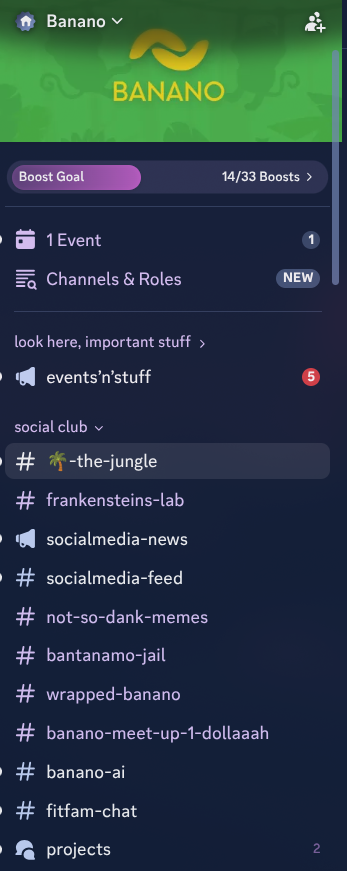
The Banano Discord server [2]
The virtual environment I observed for this assignment is “the-jungle,” a general social channel within the Banano Discord server. Banano is a meme-inspired cryptocurrency and fork of NANO, distinguished by its monkey mascot, absurdist humour, and community inside jokes. Participants, who refer to themselves as “citizens” or “monkeys,” can tip each other small amounts of BAN cryptocurrency through a dedicated server bot (currently, 1 BAN = $0.0004948 CAD
[4]
, however, monkeys would argue 1 BAN = 1 BAN). I chose this environment because I found it genuinely paradoxical that a community centered around a digital currency would treat that currency as incidental to its social life and culture. The channel description captures this: “Let’s talk about money that grows on trees and whatever else you like…”
For 48 hours between February 26 and 28, 2026, I observed the chat transcript of more than 40 participants, assuming the role of a non-participant lurker.

A visual comparison between a “Jungle Fanta” (a Banano community-contributor) versus that of a typical “citizen” versus a “non-citizen.” Citizenship is bestowed onto participants after a set amount of time and quality contributions in the chat. [2]
Observation Focus
My inquiry question for this assignment was: how does a community organized around a digital currency develop a culture of belonging, and mutual care amongst members which transcends financial premise? I was drawn to this example of digital culture because it appeared to defy the typical stereotype of cryptocurrency communities. Rather than being profit-driven, it appears to be about playful generosity, pseudonymous altruism, and a social space where internet culture and everyday life converged freely in a low-stakes environment.
As Wellman (2011) [7] argues, the Third Age of internet research treats digital spaces as infrastructure we inhabit rather than visit. For many members of the Jungle, I would say this rings true. While technically a cryptocurrency forum, the 48-hour observation window revealed a space where members greet each other by name alias, share photos of pets, meals, and personal interests through community bot commands and user submissions, while also sustaining interest-based conversations across continents and time zones. It became evident to me that the social glue here is not the financial value of the currency, but the digital friendship and internet-culture experienced in real time.
Observed Events

The BananoBot and an ode to Banano’s cryptocurrency humour [2]
The central event of my observation period was the breakdown of BananoBot, the server’s automated tipping system. A malfunction caused it to send tips approximately twenty times the intended amount before it was taken offline a day earlier. While this complicated my original inquiry, it created a fascinating involuntary natural experiment: what happens to a community built around a digital currency when that currency can no longer be shared?
Rather than frustration, I observed humour, adaptation, and continued generosity through alternative means. During the outage, members attempted to tip one another genuine amounts of 19 BAN (the number 19 being a community inside joke referencing the atomic number of potassium), unaware that the bot was offline. One member reframed the outage as a Star Wars joke. Another posted a mock tip of an absurdly large meme-number to active users, not expecting it to work but performing the gesture anyway. These responses reflect what Macfadyen (2006) [6] describes as group ritual “text acts”: communicative performances through which members collectively attest to shared identity. Drawing on Ricoeur’s concept of attestation, Macfadyen argues that virtual identity is not passively held but actively performed through repeated ritualized acts. One telling moment of this came when a server citizen attempted to tip a non-citizen and the tip failed, to which the recipient responded with genuine gratitude, noting that it was “the gesture that counted” more than the actual occurrence of the tip.
The community’s virtual culture was further recognized when some members came to the realization that the BananoBot was down and chose to adapt to another tipbot instead. As an alternative, several citizens switched to the server’s Nano tipbot as a workaround, choosing to continue the micro-tip culture through small amounts of a different cryptocurrency rather than BAN. The persistence of the tipping culture amongst the community, even with the malfunctioning bot, reveals an explicit decoupling of social value from a friendly financial transaction.
Identity Expression and Community Norms
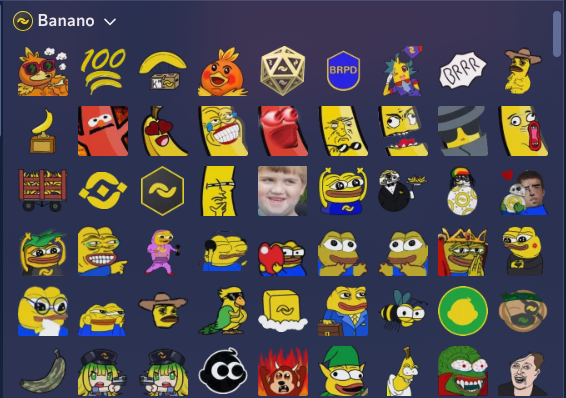
Discord server reactions and emojis unique to Banano and “the-jungle” [2]
Despite pseudonymous usernames, members displayed remarkably personal identities within this observational period. One user shared personal landscape photographs; another shared images of a hobby project; a third shared pictures of food. Cheong, Martin and Macfadyen (2012) [3] had observed that online communication is always rooted in biographical and physical realities where physical matter is important, even in digital spaces. These moments of real-world influence that appear are thought of to be the substance to which virtual identity becomes felt as genuine amongst users in the community.
Platform-specific rituals reinforced this further through: Beatrice-Bot interactions that surfaced community-submitted pet photos on demand (using !pup, and !meow commands), a recurring daily food post from one user which drew warm emoji reactions, and a spontaneous forty-minute conversation between a member from South America and another from Western Europe about concerts from a band both members had previously seen. These interactions are indicative of virtual culture not as inherited biological markers, but as a shared identity constructed through repeated, digital interactions. The food posts, the pet photos, the music conversation all being part of The Jungle’s shared customary interactions.
Another instance of community identity I observed was defined when members collectively protected against the values the group stood for. During my observation period, one member had spotted a fraudulent Banano website appearing in their search results and shared it amongst the group. Members responded quickly and without prompting, reporting the domain within minutes and determining the site functioned as a clipboard-hijacking scam designed to steal cryptocurrency. Although no one was asked to intervene, and no one was rewarded for bringing this to the attention of the group, community members responded immediately to protect the collective. What struck me about this moment was how naturally it reflected the community’s broader sense of mutual responsibility, particularly towards newcomers who might fall victim to the scam website. This was a clear example of the community’s altruistic cultural-norms extending beyond humour and social warmth into something more actively protective of the community’s identity as a whole.
Critical Reflection
In writing this, I felt my main ethical challenge was avoiding the over-romanticization of what I observed. I found it fascinating that such interpersonal cohesion existed among members who may simultaneously be experiencing real financial losses or anxieties due to the volatility of the cryptocurrency’s financial value and the stalling of the network. It was particularly interesting to witness the stalled Banano network unfolding in real time while community engagement continued uninterrupted, with no visible skepticism toward the community’s overall integrity or values. As Cheong, Martin and Macfadyen (2012) [3] note, digital spaces are characterized by fluid and often contradictory tensions. What I observed here was a community navigating those tensions with humour and unsuspecting grace. In a space centered around a digital asset, the most valuable currency appeared to be the attention, humour, and social care exchanged between members which in itself, is a form of collective attestation towards who these people are and what they stand for in this virtual space.
References
The Banano Project. (n.d.). Banano cryptocurrency.
The Banano Project. (2026). The-jungle [Screenshots]. Banano Discord server.
Cheong, P. H., Martin, J. N., & Macfadyen, L. P. (2012). Introduction: Mediated intercultural communication matters: Understanding new media, dialectics, and social change. In P. H. Cheong, J. N. Martin & L. P. Macfadyen (Eds.), New media and intercultural communication: Identity, community and politics (pp. 1–22). Peter Lang.
CoinGecko. (2026). Banano (BAN).
Ess, C., & Sudweeks, F. (2012). Foreword. In P. H. Cheong, J. N. Martin & L. P. Macfadyen (Eds.), New media and intercultural communication: Identity, community and politics (pp. xi–xx). Peter Lang.
Macfadyen, L. P. (2006). Virtual ethnicity: The new digitization of place, body, language, and memory. Electronic Magazine of Multicultural Education, 8(1).
Wellman, B. (2011). Studying the internet through the ages. In M. Consalvo & C. Ess (Eds.), The Blackwell handbook of internet studies (pp. 17–23). Wiley-Blackwell.