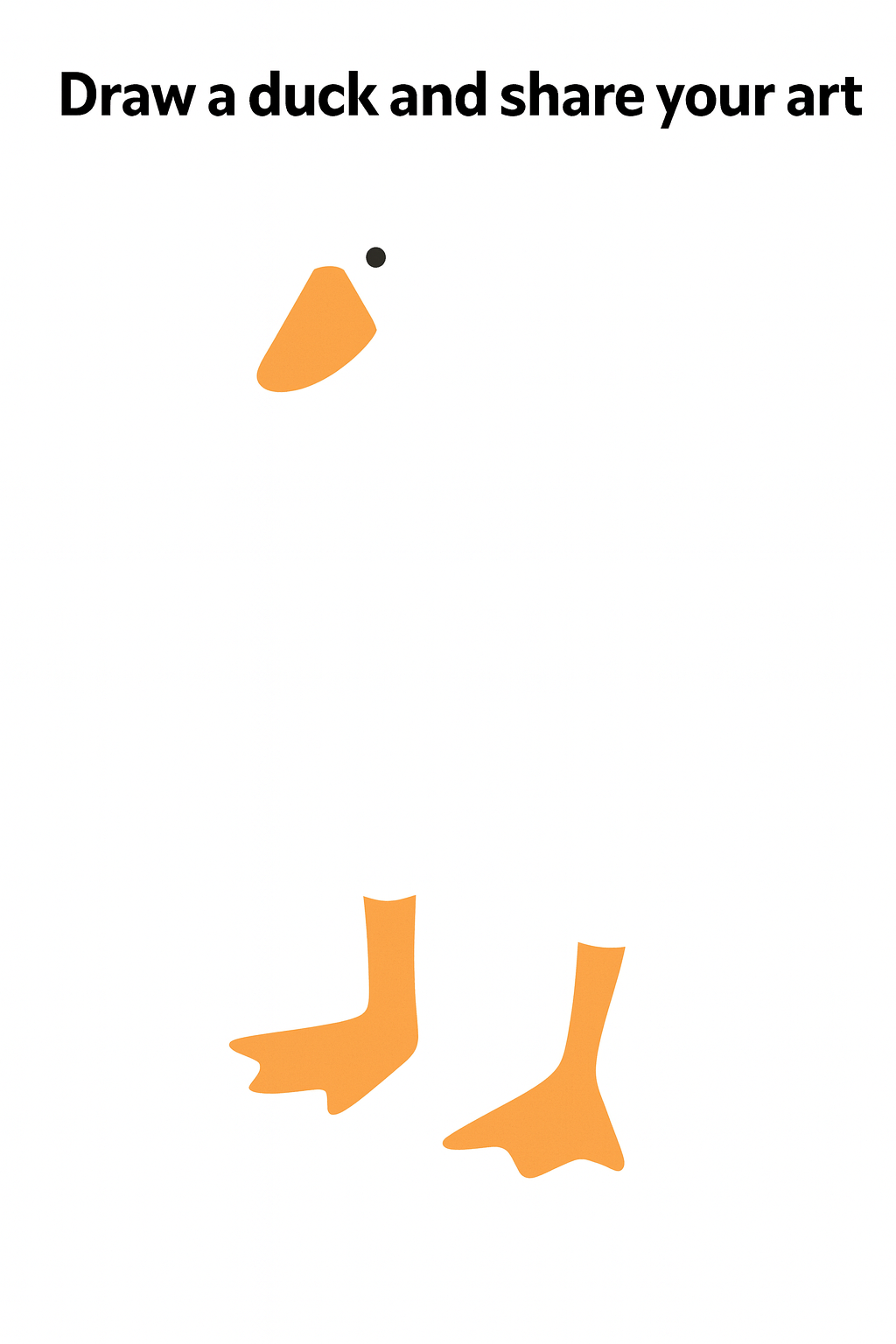
"Draw a Duck and Share Your Art" is an activity I adapted for use as an elementary substitute teacher covering one-off prep classes for 30-45 minute periods across grades K-7. The unpredictable and improvisatory nature of substitute teaching meant that I needed to be flexible, able to capture students’ attention, and maintain focus in a wide variety of contexts. This lesson became one I could rely on to do exactly that while keeping things playful and fun. Its open-ended structure allowed me to work with diverse student groups, energy levels, and behavioral contexts while still promoting a social and creative atmosphere.
The core purpose of the activity was not to teach art, but to frame drawing as an instructions-focused task that allowed for creative agency and shared meaning-making within a predetermined framework. Students demonstrated intentional choices as they navigated the semi-random open-ended criteria I wrote on the board, such as:
- a minimum of three colours
- fur, feathers, wings, arms, or scales
- a name
- an accessory
Starting the lesson with ambiguous criteria helped tap into students' imagination and their prior experiences with animals and textures, keeping them curious and invested in the task. I typically began the lesson by framing that today was as an exercise in following instructions. After greeting students and having them sit, I adopted a serious tone and explained that today's purpose was simply to follow instructions. I would ask them to stand up, sit down, switch seats, or put their hands on their heads just because I said so.
I then placed a pencil on each student’s desk and emphasized that they were not to touch it. These small theatrical choices helped build anticipation and collective focus as the lesson unfolded. Throughout this time of reiterating that today was about instructions, I would gradually add the open-ended criteria to the board, reinforcing the idea that if I asked for something with scales, wings, fur, feathers, or arms, they must follow it because that was what the activity was about.
When I felt ready, I would distribute papers face down with the explicit instructions not to flip it over or draw on it until I said so or it would be taken away. After building enough anticipation, I would finally say: “Alright, you have 10 minutes to flip over your paper and complete the criteria on the board. Good luck.” Only then did students discover they were to draw a duck and share their art.
Because I often worked with large and varied groups (20+ students) with unpredictable levels of adult support, the activity would unfold in two stages: a work period and a sharing period. Depending on the grade and behaviour, the sharing period might involve taping all drawings to the wall, a gallery walk where students were to remain following the instructions by walking in a line, or potentially shared one by one where I would present the drawings at the front of the class and add humour where appropriate (“Oh look, another goose”).
Even though the activity was open-ended, the main goal stayed consistent each time. Students had to follow the instructions and make sense of the intentionally oddball criteria through their own creative choices.
When I reflect on my “Draw a Duck and Share Your Art” activity, what stands out most is not the drawing itself, but the way students responded to the unexpected mix of structure and play. Working as an elementary K–7 teacher moving through short blocks of time, my lessons would sometimes rely heavily on quickly establishing and reinforcing expectations, as well as engaging students in classrooms generally not my own. By analyzing this activity through how children collectively think, observe one another, and negotiate understandings of the expectations through Bandura’s Social Cognitive Theory, Piaget’s constructivism, and Vygotsky’s sociocultural frameworks, it has become clear to me that there is deeper learning unfolding beneath this activity that is worth exploring.
I see Bandura’s Social Cognitive Theory happening in this lesson through how students observe one another’s work, interpret the rules, as well as navigate the perceived mistakes and successes that take place. In this short activity, I see reciprocal determinism taking place through the triadic influence of behavior, personal factors, and environment coming together to influence the learning atmosphere and dynamics that take place. The combination of these elements collectively shape what students do, how they choose to do it, as well as their own individual behaviours thereby reshaping the social environment and students' interactions between one another. This ultimately goes on to alter how the activity is engaged and unfolds over time by everyone involved.
The strongest example of this appeared during one particular class when a seven-year-old student became stuck on the “accessory” requirement of my criteria. Their hesitation marked a moment where personal cognitive factors and environmental cues collided. I watched them glance repeatedly at another student’s paper as they drew a baseball cap atop their duck’s head. Through Bandura's Social Cognitive Theory, it is explained that observational learning takes place through cycles of: attention, retention, production, and motivation. In this particular instance, the student's attention was clearly captured by the other student's drawing with the novelty of the baseball cap being influential to how they determined what accessory they would draw.
Instead of copying the baseball cap directly, I observed the student then re-process the underlying criteria that I had previously described before making a decision themselves towards what to draw on their own duck. This moment in particular was an instance that demonstrated what Bandura (2001) describes as abstract modeling. Moments later, this student produced their own interpretation of an accessory which ended up being a glittery princess crown and necklace on their duck.
In another moment, I fondly remember when another student laughed appreciatively at their fellow classmate's duck by pointing out that the wings they drew made it look like the duck was flying. In this case, the social feedback the student received acted as a motivator; aligning with Bandura’s (2012) point that self-efficacy tends to grow when individuals see others succeed and when they receive positive reactions to their own efforts. In this case, it was clear to me that this encouragement made the students' confidence shift through how they continued to add detail to their ducks' wings without any second thoughts or hesitations.
An important characteristic of this activity is the low-stakes nature the drawing provided which also parallels Bandura’s emphasis on environments that support student agency. Since the criteria that I required of the students was so broad and open-ended, there really was no “right way” to draw the duck, and because of which, students experienced minimal fear of judgment. In my opinion, this aspect of my lesson parallels Powell and Kalina's (2010) ideology that constructivist-oriented tasks tend to create safer emotional climates where students then feel more empowered to explore. In other words, the emotional safety this creates then contributes to a greater yield of experimentation and self-regulated learning within each individual student's abilities.
While Bandura helps us to explain what was observed on a social level, looking to Piaget helps us to illuminate the cognitive processes that were witnessed to be unfolding when students attempted to make sense of the odd criteria I sought. Piaget's Constructivist theory emphasizes that children construct knowledge by actively organizing information into cognitive structures (or schemas) that are then adapted through processes of assimilation and accommodation (Lourenço & Machado, 1996).
Whenever I teach this lesson, the moment students flip over their papers is the exact point I can start to witness their schemas activate, since they enter the activity with a prior mental representation of what a duck looks like. It is fascinating to watch their existing schemas become momentarily disrupted through the consideration they give towards the criteria I had requested of them in advance. Asking that their drawing must include things like "fur, wings, arms, feathers, or scales” intentionally destabilizes their previous assumptions and evokes a particular sense of creativity from them since students know that no real duck has fur or scales, yet they are required to make sense of the contradiction.
One aspect of Piaget's Constructivist Theory is that when new information does not neatly fit existing schemas, learners attempt to assimilate it into what they already understand (Lourenço & Machado, 1996). The previous example of the student's response where they saw their peer draw a baseball cap offers an example of this concept. Once they saw their classmate's creative interpretation, the student was able to re-examine the criteria with a fresh understanding of what they might do for their own duck.
Another dimension of Piaget’s Constructivist Theory that relates to this task is the emphasis on meaningful learning occurring when learners reorganize relationships between concepts rather than simply reproducing what they see. In this activity, the tension between the familiar (a duck) and the unfamiliar (my wonderfully strange criteria) created a state of cognitive disequilibrium that invited students to restructure their thinking in order to accomplish the task. As the duck drawing required students to coordinate my criteria, decide what counts as an accessory, and integrate those ideas into a coherent drawing, it engages creative reasoning and constructivist processes that Piaget viewed as central to cognitive development.
Ultimately, from a constructivist perspective, the “Draw a Duck” activity becomes a moment of active meaning-making, where students must reshape their cognitive structures and assimilate their understandings in order to creatively resolve the contradictions they are presented with.
Where Piaget focuses on how individuals reorganize their thinking, Vygotsky emphasizes that learning hinges on social interaction. John Steiner and Mahn (1996) add to this by describing learning as something that begins between people through shared activity before becoming something the individual understands on their own. This was an unmistakable part of the peer interactions I observed during this activity, as students watched one another and used those observations to make sense of the criteria, allowing their shared interpretations to shape how they understood the abstract requirements of the task.
In their work, Glassman (1994) brings up that Vygotsky’s Sociocultural theory centers on the idea that knowledge develops through socially embedded interactions, where tools and language shape how children think. As related to my activity, the criteria on the board functioned as shared classroom tools that supported students’ sense making, while their dialogue became the bridge between those tools and the ways they internally interpreted the task. In this way, the dialogue between students also reflects the Zone of Proximal Development as they engage with one another to interpret the instructions within the task’s constraints. When one student observes a classmate’s drawing, it can help them move beyond what they might have come up with on their own, as the social influence nudges them in a direction that they might not have acted on previously.
As the activity begins to wind down, the social interactions between students extend beyond their immediate neighbors. When students start to recognize the possibilities available to them, the social environment collectively shifts. Students begin comparing their ducks and enthusiastically looking to their friends’ work, which gradually aligns the class’s overall interpretation of the criteria. Powell and Kalina (2010) note that Vygotsky viewed collaboration as central to the learning process itself, and this becomes especially visible during the sharing phase of the activity. This is generally where the social nature of the meaning making that has taken place becomes even more amplified. As students observe one another’s interpretations and discover new possibilities, the social norms of the group and the collective creations they have produced become part of the learning environment. Returning to Vygotsky, the changes in social relations among students who may not have enjoyed their drawing initially become evident as they are empowered by their classmates during the sharing section. Collectively, students begin to recognize and admire the shared strategies their peers have developed and aligned together in order to complete the unique nature of the task.
Analyzing this short activity through Bandura, Piaget, and Vygotsky reveals how multidimensional even a simple drawing task can be. Bandura helps us to see how students’ confidence grew through modeling and social feedback, Piaget helps us to understand the internal cognitive shifts that reshaped students' schemas, and Vygotsky illuminates the social negotiation and meaning-making processes that occur through dialogue and collegial interaction.
While this activity generally is a one-off lesson, the learning that unfolds simultaneously through observation, internal construction, and collaborative negotiation is something students fondly remember. The activity’s playful ambiguity creates an environment where students feel obligated to exercise creativity, support one another, explore, and be creative together. What began as a trick instruction to “follow all criteria and explicit instruction very carefully" then evolves into a rich illustration of how children learn through social interaction, personal meaning making and the shared joy of creating something unexpected together.
Bandura, A. (2001). Social cognitive theory of mass communication. Media Psychology, 3(3), 265–299.
Bandura, A. (2011). Social cognitive theory. Handbook of theories of social psychology.
DeVries, R. (2000). Vygotsky, Piaget, and education. New Ideas in Psychology, 18(2–3).
Glassman, M. (1994). All things being equal: The two roads of Piaget and Vygotsky. Developmental Review, 14(2).
John-Steiner, V., & Mahn, H. (1996). Vygotskian framework. Educational Psychologist, 31(3–4).
Lourenço, O., & Machado, A. (1996). In defense of Piaget’s theory. Psychological Review, 103(1).
Powell, K. C., & Kalina, C. J. (2009). Cognitive and social constructivism. Education, 130(2).
Schrader, D. E. (2015). Constructivism and learning in the age of social media. New Directions for Teaching and Learning.